By the end of the 13th century the Braose family had rebuilt Swansea and Oystermouth castles. As part of the extensive landholdings, they also held several English estates including Bramber in West Sussex and the Gloucestershire manor of Tetbury.
|
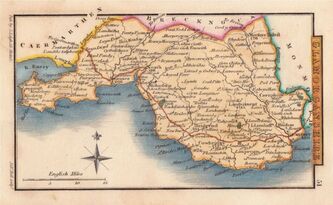
The family of Braose were a Norman family from Braose, a village not far from Falaise. They were granted estates following the conquest and became powerful through their Welsh lordships which included the Gower Peninsular. In 1203, King John, in part settlement of a debt owed to him by Waleran de Baumont, granted the Lordship of Gower to William Braose, 4th Lord of Bramber. However, by 1206, Braose had fallen from the king's favour and his lands were forfeited to the crown. In 1220, Henry III returned the barony to John Braose. By the end of the 13th century the Braose family had rebuilt Swansea and Oystermouth castles. As part of the extensive landholdings, they also held several English estates including Bramber in West Sussex and the Gloucestershire manor of Tetbury. William Braose, 4th Baron Braose was the most famous of the family. He had been one of King John's most loyal supporters and was charged, in 1201, with the capture of John's nephew, Arthur of Brittany. This action, and the fact he owed money to the king, would be William's downfall - Arthur disappeared never to be seen again, and William suspected that John had ordered the fifteen year old boys death. King John, in turn, was also suspicious of William, and became increasingly concerned about his loyalty. Within five years of the disappearance of Arthur, John's paranoia grew to the point that he ruthlessly hounded the family. History doesn't say whether William used his inside knowledge of the situation with Arthur to his advantage, but it is thought that his wife Maud Valery may have said too much about what she knew. Whoever said what to whom, the king took it out on Maud, imprisoning her, along with her eldest son in a cell either at Windsor or Corfe castles, where they were left to starve to death. William had previously fled and died in exile in France. The last of the Braoses’ was William, Baron Braose, the great grandson of William, 4th Baron Braose whose daughter's Aline and Joan were his heirs. On their marriages, the land of their forefathers passed to the Mowbray family. William Braose, Ist Baron Braose feature in the life of my ancestor John Umfreville
0 Comments
Medieval grants were often documented through charters, which required confirmation. The confirmation process involved witnesses and seals to make the grant official. Confirmation grants, such as those issued by the Braose family in the 13th century, served to officially recognise and legitimise ownership, rights and privileges. They served to maintain the social order and prevent future disputes. It was at this time that freehold estates turned into what we now know as parishes, and along with the development of these parishes new towns appeared, and this in turn heralded the arrival of the borough - places where tenements created by rural lords were to be held in burgage - that is, buildings/land held by payment of rent. The burgage system originated before the time of the conquest and had a real impact on English towns and cities. The growth and prosperity of the town of Tetbury in Gloucestershire, can be credited to William Braose, 4th Baron Braose, who relinquished his feudal rights in his manor and established ten burgages. The merchants who held them are named in his charter. The family of Valery held Tetbury from 1148 until they were deprived of it in 1197 during the tenure of Thomas Valery. It was then granted to William Braose, 4th Lord of Bramber, probably on his marriage, c1166, to Maud Valery. (1) However, Tetbury was confiscated in 1208 following a major fall out with King John which resulted in the cruel deaths, in 1211, of Maud and her eldest son William, (2) In October 1216, Margaret Braose (3) was granted (4) ‘three carucates of land by King John, to be cleared and cultivated, in the forest of Aconbury, to found a religious house there for the salvation of the souls of her father, her mother and her brother' (5) and from which the nuns received rent from the Tetbury burgages at a rate of £148d annually. The family's holdings were restored to them following the king’s death in 1216, and the ownership of Tetbury ping ponged between members of the Braose family and several other nobles until 1226 when it was granted to John Braose, the grandson of the 4th Lord of Bramber. John held the manor until his death in 1232 when it reverted to the crown during the minority of his son William, later 1st Baron Braose. William came of age in 1254; he held the manor until his death in 1291 after which it passed to Peter, his son by his third wife Mary Roos. The original charter of William Braose was first confirmed by his brother Reginald. In 1230, it was confirmed (6) by William’s son John. In 1268, a further grant was made, possibly by William’s stepmother, to the Tetbury burgesses - "to hold to them also y liberties and ffiree customes contained in the Britain Law, in a ample manner as the burgesses of Hereford had or used." (7) John Braose died in a riding accident on his estate at Bramber in 1232, leaving William, 1st Baron Braose as his heir. He had married the daughter of Llywelyn the Great and had served under both Henry III and his son Edward I. One of the first things Edward did when he became king in 1272, was to make sure that the crown profited from growing trade. In 1278, he ordered an enquiry examining liberties within his realm. Under the Statue of Gloucester, he declared ‘We must find out what is ours, and due to us, and others what is theirs, and due to them.’ It was under this statue that in 1287, he brought a Writ of Quo Warranto (8) (by what warrant) against William ‘for the liberties he claimed in Tetbury.’ William’s case was brought under a Court Leet ‘where upon it was found that Tetbury was an ancient borough town and that in the same he had a market and fair’ (9) On the 20th January 1290, a year before his death, William inspected the charter made by his father to the nuns of Aconbury Abbey, and two days later, in London he confirmed and put his seal to it. (10) ‘...In that village which lies in the village of Tetbury, the burgage of Reginald Palmer (11) is ten and eight pence, and a stipend. Of the burgage of Richard Hiredmon twelve pence, Of the burgage of William the Hunter ten and eight pence: Of the burgage of John Cooper twelve pence: Of the burgage of William Rufus two pence: Of the relict of John Godin twelve pence: Of the burgage of Richard de Themeld five pence: Of the burgage of Thomas five pence: Of the burgage of the relict of Rad. five pence; of the burgage of John de Machim five pence: And of the two forelands, fifteen pence; namely, of the foreland of John W..., which lies before the church land, eight pence; and of the foreland of Roger Brumier, which lies behind his burgage, eight pence; to be received from the hands of the aforesaid and their heirs on the day of the blessed Andrew the Apostle, so that all these priests Burghs and their heirs, are all intending to answer the priests of the house of the Hospital of Aconbury by reason of the priests of the burgages and the liberties granted in my town of Tetbury from all the zeal of the church, and from all the exactions, and from the demands; and they have full liberties in my town of Tetbury, and in the common pastures fruitful tenor of the privileges of the house of the Hospital of John, of the land of Jerusalem, ,......’ I desire that these donations of mine, ratified and valid, may remain, having confirmed my charter to the above; and I have confirmed by my signature; these witnesses are John de Umfreville; (12) then steward; Magistrate Richard de Burleia; Geoffrey de Chaplain, then procurator of the House of Comeberi; Stephen Chaplain of the same place; Allan Chaplain of Tettebiria; Roger de Wathtiam; Philip de Tettebiria; William de Redmerton; Walter de Upton; Joanna Deacon who wrote this Charter and many others.’ (13) Today, the town of Tetbury still maintains its links to the Braose charters, you can read about this here: Edward I is known to history as Longshanks, a physically impressive man who was six feet two in height and seen as an able and courageous warrior whose dislike for the Weslh Prince Llywelyn ap Gruffudd resulted in a second war when, early in 1277, the king deployed his forces in south and mid-Wales. These armies included the marcher lord's retainers, such as my ancestor Henry Umfreville. They met with considerable success as many of the native Welsh rulers, resentful of Llywelyn's overlordship, surrendered and joined the English. Eventually, by the end of that year, Edward I and Llywelyn settled for peace with the Treaty of Aberconway. The treaty was ratified at Aberconwy Abbey, now St Mary and All Saints’ Church in Conway in Wales on the 10th November 1277.This treaty between Edward I of England and Welsh prince Llywelyn ap Gruffudd, guaranteed peace but limited Llywelyn's power to the west of the River Conwy. This peace however, did not last and by 1282 war had broken out again when Llywelyn joined his brother Daffyd in rebellion.
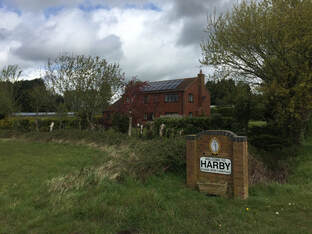
On the 28th November in 1290 in the Nottinghamshire village of Harby, Eleanor of Castile, the beloved wife of Edward I died. It is thought that Eleanor had not properly recovered from catching malaria a few years earlier, and it was on her journey to pray at the Shrine of St Hugh in Lincoln Cathedral that she became ill. On the 13th November, once parliament had concluded at King’s Clipstone, the royal party began their journey into Lincolnshire, but Eleanor's health deteriorated so they stopped at Harby, the home of Richard de Weston, in the hope that she regain her strength. According to Edward’s itinerary, they arrived at Harby on the 20th November, it was here eight days later that Eleanor died. The king was with her at her request, Oliver Sutton, the Bishop of Lincoln, and Harby’s parish priest, William de Kelm were also in attendance. Eleanor’s body was conferred to St Catherine’s Priory in Lincoln where it was embalmed. The queen's viscera were buried in Lincoln Cathedral, where Edward would place a copy of her Westminster Abbey tomb. King Edward’s grief at the loss of his wife is well known as is the fact that at each place his queen's body rested on her journey to London he erected crosses, all different and all beautifully ornate. The first one placed was at St Catherine’s, sadly nothing but a stump remains, and this can be found in the grounds of Lincoln Castle. At Harby, a chantry chapel was established in 1294 where prayers were said for the queen's soul and this was done until the dissolution, however the building itself survived until 1877. We were at Harby last year, it was a cold and wet day, much like the day in 1290. The manor house in which Queen Eleanor died is long gone, but you can walk to the site on which it stood, also to be seen are the remains of the moat that once surrounded it. The aforementioned Chantry Chapel once stood behind the iron railings, on the spot where the above was taken.
There seems to be a bit of a disagreement among historians as to the reasons King John married his second wife Isabella of Angouleme, some say it was born out of lust, others out of the need to control the areas that neighboured Angouleme. John, it has been said, took an immediate fancy to Isabella, the daughter of Audemar the Count of Angouleme, and was quick to make a play for her. John certainly loved women, he was unfaithful to both his wives and kept numerous mistresses, some of them married women, so it is easy to believe that he was determined to have her and was not going to take no for an answer.
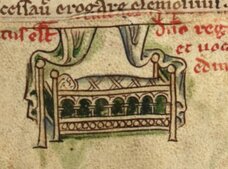
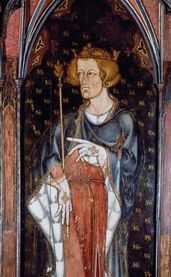
There was a big difference in their ages, John was nearly thirty-four and Isabella was about fifteen when they married on the 24th of August 1200. The birth of their firstborn suggests that the king may have respected her tender age and stayed out of the marriage bed until at least the end of 1206. Following their marriage, the couple arrived back in England, where on this day, the 8th October 1200, Isabella was crowned at Westminster Abbey. The view that most historians put forward, that King John was a tyrant and a thoroughly bad chap with absolutely no redeeming features, makes it difficult to find anything positive to say about his twelve-year marriage to Isabella, but from what I have read it looks to be an exact copy of that of John's parents Henry II and Eleanor of Aquitaine. John was a philanderer, so was Henry, Isabella a been a strong and forceful woman, so was Eleanor. Soon after John's death in 1216, Isabella left her children, the youngest just a year old, in the care of the English court, and made a new life for herself with a new husband in her home of Angouleme. In the late evening of the 17th June 1239 Edward I was born to Henry III and Eleanor of Provence, he was probably named after Edward the Confessor. On the death of his father in 1272, Edward inherited the English throne. He would build castles in Wales to subdue the Welsh and make his son the first Prince of Wales. By 1290, he moved on to Scotland and angered the Scottish nobility by deciding who would succeed to the Scottish throne. He chose John Balliol. In retaliation the Scottish deposed Balliol and formed an alliance with France. Edward then invaded Scotland, imprisoned Balliol in the Tower of London and placed the Scottish people under English rule. For this he was given the name of Hammer of the Scots. Edward had a second nickname, that of Longshanks because of his height - he was six foot two. Historian Michael Prestwich wrote of this that Edward's "Long arms gave him an advantage as a swordsman, long thighs one as a horseman'
Did you know that Exeter was the centre of the Devon export trade? In the 13th century, the Countess Wear Bridge (Weare was an estate, owned by the Earls of Devon, which was part of the manor of Topsham) This weir was named after Isabella de Fortibus, an ancestor of the Courtenay family. It has been stated that the countess built the weir in 1284, this caused problems with salmon fishing, it would also, later years prevent boats from reaching Exeter.
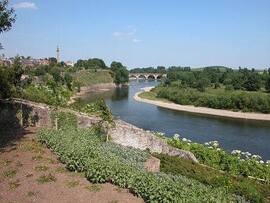
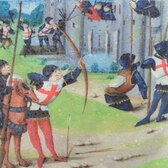
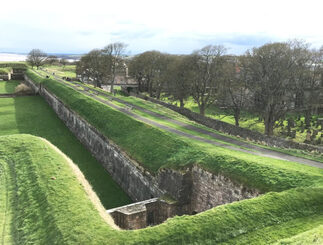
Another source states that Isabella built the weir ten years earlier incorporating a huge gap in the centre through which boats could pass. This gap however, was eventually blocked between the years 1307 and 1377 by her kinsmen Hugh Courtenay and his son also named Hugh, and as mentioned it had the effect of preventing ships reaching the quay at Exeter and thus forcing them to use the nearby port of Topsham. The ship owners had to pay a fee the Courtenay's for the privilege. From the 16th through to the 18th century the city played an important part in processing and exporting woollen cloth. Scotland, according to Edward I, was his domain. When Scotland refused to support England’s military campaign against France Scotland made an alliance with the French and attacked the English town of Carlisle. Edward retaliated and launched an attack on Berwick on Tweed. This was first altercation in the Scottish War of Independence, the second was the Battle of Dunbar in April. Edward I mustered his forces and arrived in Northumberland on the 28th March 1296, crossing the River Tweed at Coldstream, a small village south-west of the town, and set up camp at the priory there. Berwick was Scotland's most important port and it was by sea that the English forces made their initial attempt to take the town, however this failed. On the 30th the town surrendered leaving between 4,000 to 17,000 people dead. 'When the town had been taken in this way and its citizens had submitted, Edward spared no one, whatever the age or sex, and for two days streams of blood flowed from the bodies of the slain, for in his tyrannous rage he ordered 7,500 souls of both sexes to be massacred. So that mills could be turned by the flow of their blood.' Account of the Massacre of Berwick, from Bower’s Scotichronicon After the town was taken the king issued orders for new fortification to be built. According to the chronicle of Walter of Guisborough, the finished ditch was 40 feet deep and 80 feet wide, which was topped by a timber palisade. The control of this Northumbrian town ping-ponged between the English and the Scots for years, however, the Scottish army would retake the town following the Battle of Stirling Bridge in 1297, but it would be back in English hands by 1298.
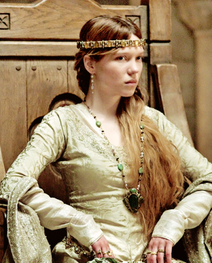
On this day in 1236 the marriage of Eleanor of Provence to Henry III. Eleanor was twelve when she arrived in England to marry the twenty-eight-year-old Henry, who she had never met.
A beauty by all accounts Eleanor was dressed in a shimmering golden outfit that 'fitted tightly at the waist and flared out to wide pleats at her feet. The sleeves were long and lined with ermine.' There was talk that Eleanor could not give Henry an heir, but their first child, the future Edward I, was born three years later, and other children followed in quick succession. Henry was very fond and loving towards his five children and detested spending long periods of time apart from them. Eleanor outlived Henry by nineteen years. Henry and Eleanor were the last of my monarch ancestors, it was a long long descent via their son Edmund, Earl of Lancaster, through princesses, nobility, gentry and farmers before my arrival in the world. There are a number of areas in the country that lays claim to being the place where King John put his seal to the Magna Carta in the June of 1215. One of them lies in the Thames in Berkshire and is known as Magna Carta Island. Magna Carta was supposed to have been spread out on an octagonal stone, which still remains, in what is known as the Charter Room of a small house that stands on the island. Interestingly, just across the water is Runnymede, the traditional area associated with this famous document.
The island is also where Henry III and the future Louis VIII of France met in 1217. |
Archives
August 2026
Categories
All
After ten years in the workplace I became a mother to three very beautiful daughters, I was fortunate enough to have been able to stay at home and spend my time with them as they grew into the young women they are now. I am still in the position of being able to be at home and pursue all the interests I have previously mentioned. We live in a beautiful Victorian spa town with wooded walks for the dog, lovely shops and a host of lovely people, what more could I ask for.
All works © Andrea Povey 2014. Please do not reproduce without the expressed written consent of Andrea Povey. |


RSS Feed