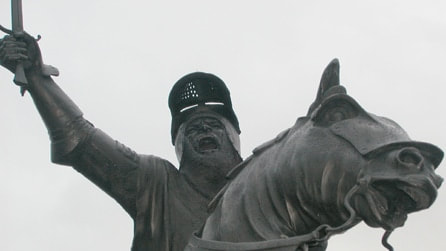
By the end of the 13th century the Braose family had rebuilt Swansea and Oystermouth castles. As part of the extensive landholdings, they also held several English estates including Bramber in West Sussex and the Gloucestershire manor of Tetbury.
|
The family of Braose were a Norman family from Braose, a village not far from Falaise. They were granted estates following the conquest and became powerful through their Welsh lordships which included the Gower Peninsular. In 1203, King John, in part settlement of a debt owed to him by Waleran de Baumont, granted the Lordship of Gower to William Braose, 4th Lord of Bramber. However, by 1206, Braose had fallen from the king's favour and his lands were forfeited to the crown. In 1220, Henry III returned the barony to John Braose. By the end of the 13th century the Braose family had rebuilt Swansea and Oystermouth castles. As part of the extensive landholdings, they also held several English estates including Bramber in West Sussex and the Gloucestershire manor of Tetbury. William Braose, 4th Baron Braose was the most famous of the family. He had been one of King John's most loyal supporters and was charged, in 1201, with the capture of John's nephew, Arthur of Brittany. This action, and the fact he owed money to the king, would be William's downfall - Arthur disappeared never to be seen again, and William suspected that John had ordered the fifteen year old boys death. King John, in turn, was also suspicious of William, and became increasingly concerned about his loyalty. Within five years of the disappearance of Arthur, John's paranoia grew to the point that he ruthlessly hounded the family. History doesn't say whether William used his inside knowledge of the situation with Arthur to his advantage, but it is thought that his wife Maud Valery may have said too much about what she knew. Whoever said what to whom, the king took it out on Maud, imprisoning her, along with her eldest son in a cell either at Windsor or Corfe castles, where they were left to starve to death. William had previously fled and died in exile in France. The last of the Braoses’ was William, Baron Braose, the great grandson of William, 4th Baron Braose whose daughter's Aline and Joan were his heirs. On their marriages, the land of their forefathers passed to the Mowbray family. William Braose, Ist Baron Braose feature in the life of my ancestor John Umfreville
0 Comments
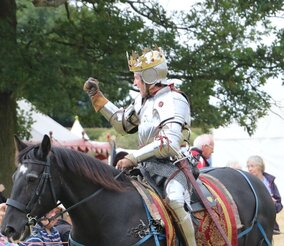
Edward I is known to history as Longshanks, a physically impressive man who was six feet two in height and seen as an able and courageous warrior whose dislike for the Weslh Prince Llywelyn ap Gruffudd resulted in a second war when, early in 1277, the king deployed his forces in south and mid-Wales. These armies included the marcher lord's retainers, such as my ancestor Henry Umfreville. They met with considerable success as many of the native Welsh rulers, resentful of Llywelyn's overlordship, surrendered and joined the English. Eventually, by the end of that year, Edward I and Llywelyn settled for peace with the Treaty of Aberconway. The treaty was ratified at Aberconwy Abbey, now St Mary and All Saints’ Church in Conway in Wales on the 10th November 1277.This treaty between Edward I of England and Welsh prince Llywelyn ap Gruffudd, guaranteed peace but limited Llywelyn's power to the west of the River Conwy. This peace however, did not last and by 1282 war had broken out again when Llywelyn joined his brother Daffyd in rebellion.
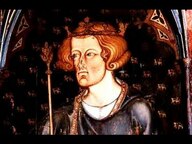
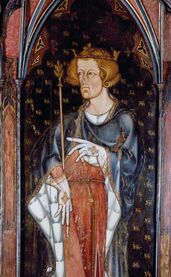
In the late evening of the 17th June 1239 Edward I was born to Henry III and Eleanor of Provence, he was probably named after Edward the Confessor. On the death of his father in 1272, Edward inherited the English throne. He would build castles in Wales to subdue the Welsh and make his son the first Prince of Wales. By 1290, he moved on to Scotland and angered the Scottish nobility by deciding who would succeed to the Scottish throne. He chose John Balliol. In retaliation the Scottish deposed Balliol and formed an alliance with France. Edward then invaded Scotland, imprisoned Balliol in the Tower of London and placed the Scottish people under English rule. For this he was given the name of Hammer of the Scots. Edward had a second nickname, that of Longshanks because of his height - he was six foot two. Historian Michael Prestwich wrote of this that Edward's "Long arms gave him an advantage as a swordsman, long thighs one as a horseman'
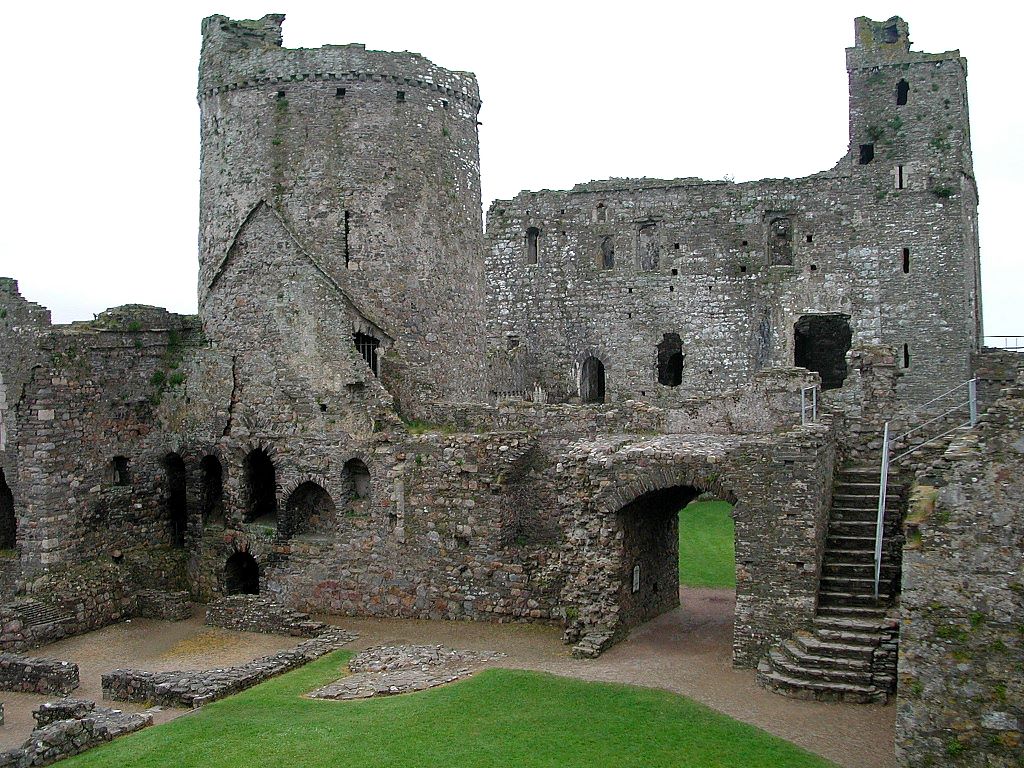
Maud de Charworth was a wealthy heiress, the only daughter of Welsh baron Patrick de Charworth. At the age of just one Maud inherited the manor of Kidwelly in Carmarthenshire, Southwest Wales when her father and his older brother died whilst in the Holy Land. Maud, due to her young age, became the ward of Edward I's queen Eleanor. Her marriage in 1291 was granted to the king's brother, Edmund, Earl of Lancaster, who gave Maud in marriage to his son Henry of Lancaster and it was on this day in 1296/7 that the pair were married. Maud gave birth to seven children. Her eldest was her son Henry of Grosmont, whose daughter Blanche would become the first wife of John of Gaunt. Their sixth child their daughter Eleanor was my 20x great grandmother via her marriage to Richard Fitzalan. Kidwelly Castle, seen here, may have been the birth place of Maud, was held by the in the 12th century by Maurice de Londres. The castle was lost to the Welsh during the uprising in the 13th century and then granted to Hawise de Londres and then to the Charworths on Hawise's marriage to Maud's father. In the mid 14th century the castle and the Charworth lands landed into the lap of John of Gaunt.
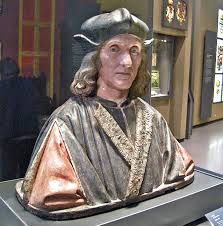
On this day in 1457 Henry of Richmond, later Henry VII was born at Pembroke Castle to Margaret Beaufort and Edmund Tudor. In 1455, at the age of just twelve years old Henry's mother, a wealthy heiress had married Edmund Tudor, the son of a commoner who had climbed into the bed of a queen of England. Margaret was soon pregnant. Henry was born into a country that was divided by conflict and civil war. Margaret Beaufort was just a child herself and Henry's birth did irreparable damage, this could account for the fact that she never gave birth again, however she turned out to be an influential and dominant figure throughout Henry's life. Margaret was also aware of her son's vulnerability and because of this sent him into the care of his uncle, Jasper Tudor. Following the Battle of Tewkesbury in the May of 1471 Jasper and Henry fled to Brittany and then finally into France. Henry spent, in total, fourteen years of his life in exile. His return to England in 1485 has been much written about, and most of you will know that he was aided at the Battle of Bosworth by Thomas Stanley, his mother's husband and his brother William. Henry of Richmond became king of England on the 22nd August in 1485.
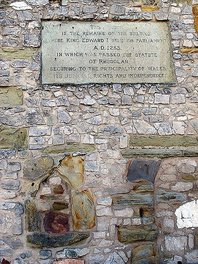
I, of course, am a Ricardian and see Henry as a usurper, whose claim to the throne is a tenuous one to say the least, however, Richard and Henry's stories are real and to understand Henry, Richard and the Wars of the Roses it is always best to read widely with the aim to gain an understanding of both sides of story, therefore I add this paragraph taken from the Henry Tudor Society about Henry. "He is a king often accused of being parsimonious, miserly, ruthless, severe and avaricious to the extreme, cold to his wife and cruel to friend and foe alike. The study of Henry’s life, from his beginnings through to the exile, and from his early reign to the tragic end, put forward a different man. It is this man, the real Henry, not the mythical Henry, that we aim to bring to the fore. A man who had an astounding tenacity to survive, to cling to his throne and to pass his crown to his son in a peaceful manner, something which eluded several monarchs before him." Here a link to the Henry Tudor Society - www.tudorsociety.com/ It was today in 1284, in the Welsh town of Rhuddlan that an act, known as the Statute of Rhuddlan, became law. This meant that the people of Wales had to abide by the laws of England and that Edward I was able to place of his choice of officials in important positions. Seventeen years later in 1301, he would reinforce his claim to Wales by making his son, Edward of Caernarfon, Prince of Wales. By 1535, under the Laws of Wales Act, Wales became part of England, a single state under English laws, since then its Englishness/Welshness has become a subject open to interpretation.
One thousand four hundred, no less and no more, Was the date of the rising of Owen Glendower; Till fifteen were added with courage ne’er cold Liv’d Owen, though latterly Owen was old. These words were written by Lo Goch or Llwyd, Owen Glendower's bard.
George Borrows writes in his work The Welsh and Their Literature that Lo Goch "composed this ode two years before the great Welsh insurrection, when he was more than a hundred years old. To his own great grief he survived his patron, and all hopes of Welsh independence. An englyn, which he composed a few days before his death, commemorates the year of the rising of Glendower, and also the year to which the chieftain lived." Welsh hero, Owen Glendower was proclaimed Prince of Wales in 1400 and is still remembered and revered today as a man who will one day return and free the Welsh from English oppression. It was through Borrow's work, that I first learnt about Welsh poets such as Lewis Glyn Cothi and Hew Cae Llwyd, his writings were an aid in my research into the life of my ancestor Thomas Vaughan who was executed at Pontefract in 1483. Borrows work was useful too when I was researching my paternal ancestry, giving me an insight into my Welsh ancestry and a look at the towns and villages these ancestors once inhabited. George Borrow's work, I feel, is much overlooked but it is historically important, therefore I have included a link to the George Borrows Society. georgeborrow.org/static/georgeBorrowSociety.html |
Archives
July 2025
Categories
All
After ten years in the workplace I became a mother to three very beautiful daughters, I was fortunate enough to have been able to stay at home and spend my time with them as they grew into the young women they are now. I am still in the position of being able to be at home and pursue all the interests I have previously mentioned. We live in a beautiful Victorian spa town with wooded walks for the dog, lovely shops and a host of lovely people, what more could I ask for.
All works © Andrea Povey 2014. Please do not reproduce without the expressed written consent of Andrea Povey. |
RSS Feed